
Why do many engineers prefer Velcro cable ties over standard nylon cable ties?
Quick Answer:
Traditional cable ties create a permanent fixing that often needs to be cut and replaced whenever cables are added or removed. This increases maintenance time, generates waste, and can potentially damage sensitive data or communication cables if overtightened.
The Solution:
Velcro cable ties offer a flexible, reusable alternative that allows engineers to modify cable installations quickly and safely. They help protect cables, simplify maintenance activities, and reduce long-term costs by eliminating the need for repeated tie replacement.
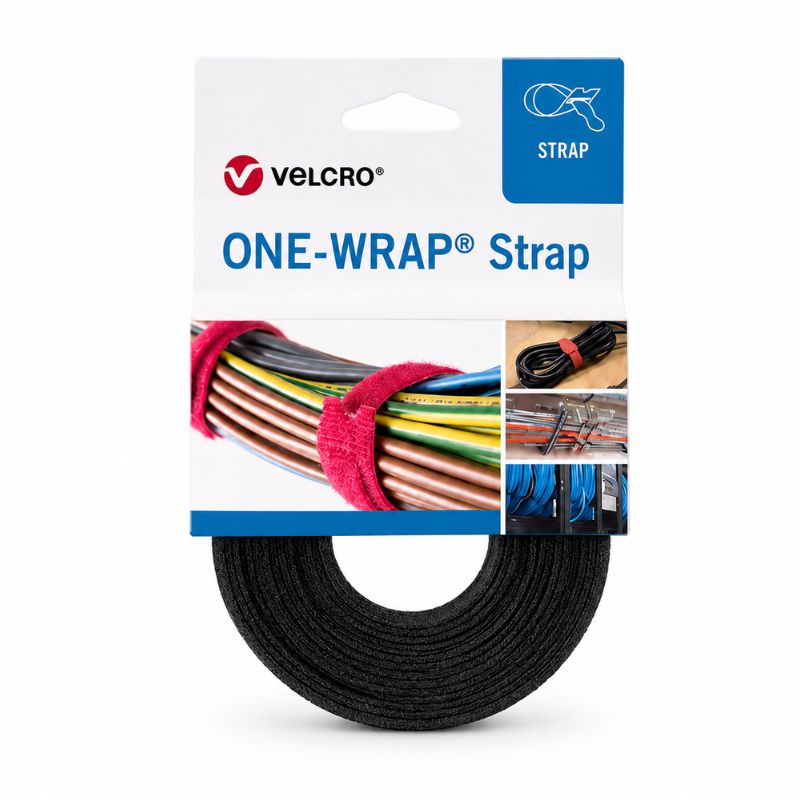


Want to find out more?
When should you use Velcro cable ties instead of traditional nylon cable ties? This question is common among engineers, installers, and maintenance teams looking to improve cable management while protecting valuable infrastructure.
Traditional cable ties are widely used because they are inexpensive and simple to install. However, many modern systems require flexibility rather than permanence. As networks grow and industrial systems evolve, cables often need to be added, removed, or rerouted. In these situations, reusable Velcro cable ties offer significant advantages.
One of the primary benefits is accessibility. A technician working on a server rack or control cabinet can open a Velcro tie in seconds, access the required cables, and resecure the bundle immediately afterwards. Nylon ties, by contrast, must be cut and replaced every time modifications are needed.
Cable protection is another important consideration. Many communication and data cables are sensitive to excessive compression. Overtightened plastic ties can distort cable jackets and place strain on internal conductors. Velcro ties distribute pressure more evenly, helping maintain signal integrity and extending cable life.
Maintenance efficiency also improves when reusable ties are used. Consider a manufacturing facility where sensors and control devices are upgraded regularly. Replacing plastic ties throughout the maintenance process adds labour time and generates unnecessary waste. Velcro ties simplify the process and support faster completion of tasks.
Engineers should still follow best practices. Cables should be routed logically, grouped by function, and supported appropriately. Power and data circuits should be separated where practical to improve organisation and simplify troubleshooting.
Colour-coded Velcro ties can provide additional benefits. Different colours can identify systems, departments, or cable types, helping technicians locate connections quickly. This is especially valuable in large installations where hundreds of cables may be present.
Although the purchase price of a Velcro tie is often higher than that of a standard nylon tie, the long-term value can be greater. Reusability reduces replacement costs and lowers overall maintenance effort throughout the life of the installation.
Fairline supports customers across industrial, commercial, and technical sectors where efficient cable management is critical. In many applications, reusable fastening solutions help improve serviceability while protecting important cable assets.
For organisations seeking a practical and professional cable management solution, Velcro cable ties deliver clear advantages. They reduce waste, improve flexibility, and support efficient maintenance, making them a preferred choice for many modern engineering applications.