
CPR FIRE CLASSIFICATIONS
The Construction Products Regulation, commonly abbreviated to CPR, provides a standard method of classifying how permanently installed cables react when exposed to fire.
CPR applies to copper data, telecommunications and fibre-optic installation cables that are intended to become a permanent part of a building or other construction work. The classification considers factors including flame spread, heat release, smoke production, flaming droplets and the acidity of gases released during combustion.
A CPR rating describes a cable’s reaction to fire. It does not mean that the cable will continue operating during a fire. Cables required to maintain power or communications for emergency systems must meet separate fire-resistance and circuit-integrity requirements.
CPR Cable Euroclasses
| CPR Euroclass | Relative fire performance | What the classification means | Structured cabling guidance |
|---|---|---|---|
| Aca | Highest | Virtually no contribution to fire, based primarily on the cable’s heat of combustion. | Extremely uncommon for conventional copper or fibre structured cabling and generally limited to specialist applications. |
| B1ca | Very high | Very limited flame spread, heat release and fire growth under stringent test conditions. Smoke, flaming droplets and acidity are also classified. | Normally reserved for specialist, critical or exceptionally high-risk projects where it is specifically required by the fire strategy or project specification. |
| B2ca | High | Low contribution to fire, with stricter flame-spread and heat-release limits than Cca. Smoke, droplets and acidity are also classified. | May be specified for high-occupancy, critical-infrastructure or difficult-evacuation environments such as hospitals, transport facilities, high-rise buildings and some public buildings. It is not automatically required in every building of these types. |
| Cca | Enhanced | Limited contribution to fire, with testing for flame spread, heat release, fire growth, smoke production and flaming droplets. | Cca-s1b,d2,a2 is the minimum classification specified by BS 6701 for permanent telecommunications installation cables within the external fire barriers of UK buildings and structures. A higher class may still be required by the project specification or fire-risk assessment. |
| Dca | Moderate | Provides better performance than Eca but permits greater flame spread, heat release and fire growth than Cca. Smoke, droplets and acidity can also be classified. | Below the BS 6701 minimum for UK telecommunications installation cable. It should only be used where the system designer, client and applicable project specification permit it. |
| Eca | Basic | Demonstrates basic resistance to vertical flame propagation on an individual cable. Heat release, smoke, droplets and acidity are not additionally classified. | Does not meet the BS 6701 minimum for permanent telecommunications installation cable. It may be encountered on other cable types, cords or applications, subject to the cable’s intended use and project requirements. |
| Fca | Lowest | Does not meet the Eca flame-propagation criterion, or has no meaningful reaction-to-fire performance declared beyond the lowest CPR class. | Not recommended for permanently installed structured cabling within buildings. |
How to Read a CPR Cable Rating
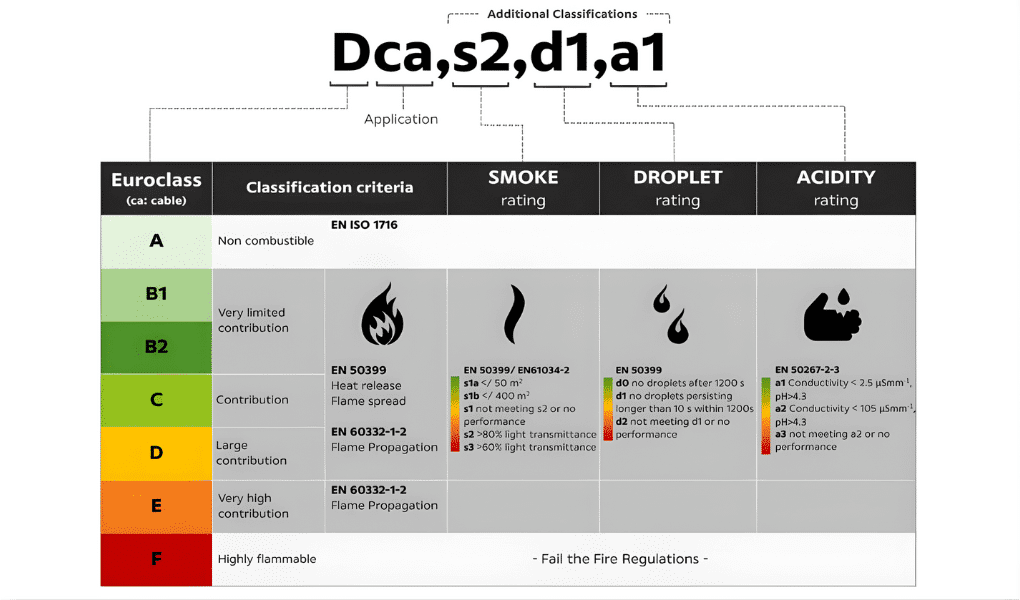
A complete cable rating may appear as:
Cca-s1b,d2,a2
The first section gives the cable’s main Euroclass. The remaining sections describe its smoke production, flaming droplets and acidity.
| Rating element | Available classifications | Meaning |
|---|---|---|
| Main Euroclass | Aca, B1ca, B2ca, Cca, Dca, Eca or Fca | The cable’s overall reaction-to-fire performance, principally based on flame spread, heat release and fire growth. Aca is the highest class and Fca is the lowest. |
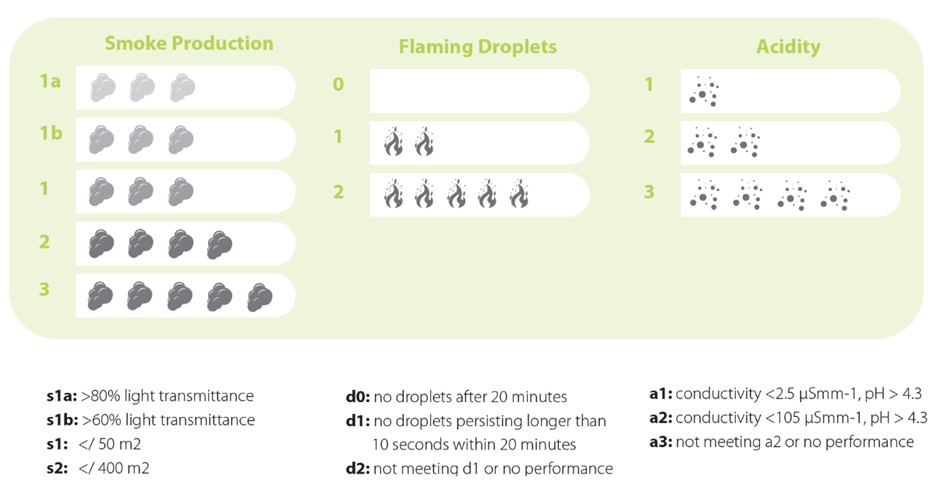
| Smoke – s | s1a, s1b, s2 or s3 | The quantity and density of smoke produced. s1a provides the highest smoke performance, followed by s1b, s2 and s3. The s1a and s1b classifications include additional smoke-density testing. |
| Flaming droplets – d | d0, d1 or d2 | Whether burning droplets or particles are produced. d0 is the highest performance, d1 permits limited droplets and d2 is the least stringent classification. |
| Acidity – a | a1, a2 or a3 | The acidity and conductivity of gases released by the cable. a1 provides the lowest acidity and corrosivity, followed by a2 and a3. |
Therefore, a cable rated Cca-s1b,d2,a2 has:
- Cca overall reaction-to-fire performance;
- high smoke-performance classification;
- the least stringent flaming-droplet subclass; and
- reduced acidity and corrosivity compared with an a3-rated cable.
UK Structured Cabling Requirement
For new installations and the refurbishment or extension of existing installations, BS 6701 specifies that telecommunications installation cables installed within the external fire barriers of a building or structure should meet, as a minimum:
Cca-s1b,d2,a2
This applies to permanently installed copper and fibre-optic telecommunications cabling. Higher-performance classifications, such as B2ca, may be required where identified by the building’s fire strategy, contractual specification, insurer, consultant or responsible designer.
The CPR system itself does not assign a mandatory cable class to every type of building. Cable selection must consider the relevant Building Regulations, fire strategy, risk assessment, installation standard and individual project specification.
CPR Is Not the Same as LSZH
The terms LSZH, LSOH and halogen-free describe characteristics of the cable’s materials and the gases or smoke that may be produced during combustion. They are not CPR Euroclasses.
Two cables described as LSZH can have different CPR classifications. Always check the complete Euroclass and the manufacturer’s Declaration of Performance rather than relying only on an LSZH description.
What to Check Before Ordering Cable
Before selecting structured installation cable, confirm:
- The full CPR classification, including smoke, droplets and acidity.
- Whether the cable meets the project’s specified Euroclass.
- That a Declaration of Performance is available.
- That the product carries the appropriate CE or UKCA conformity information.
- Whether additional fire-resistance or circuit-integrity performance is required.
- That the classification applies to the exact cable product and part number being supplied.
Where the required classification is unclear, the project designer, fire engineer or responsible specifier should confirm the appropriate cable before installation.
Fairline provides structured network cabling with all necessary CPR Fire Classifications. Whether you need Dca, Cca, B2ca or Eca.
See all information to check which rating you require, then simply get in touch with us and we’ll supply the right cabling for you!

Fairline also offer VAT included prices at Computerstar. Find your technology solution online and order with ease!