
How can I organise cables effectively without making future maintenance more difficult?
Quick Answer:
Many cable management issues are caused by using permanent fastening methods that make it difficult to add, remove, or identify cables later. Poorly organised cable bundles can increase maintenance time, create confusion during troubleshooting, and even put unnecessary strain on cables.
The Solution:
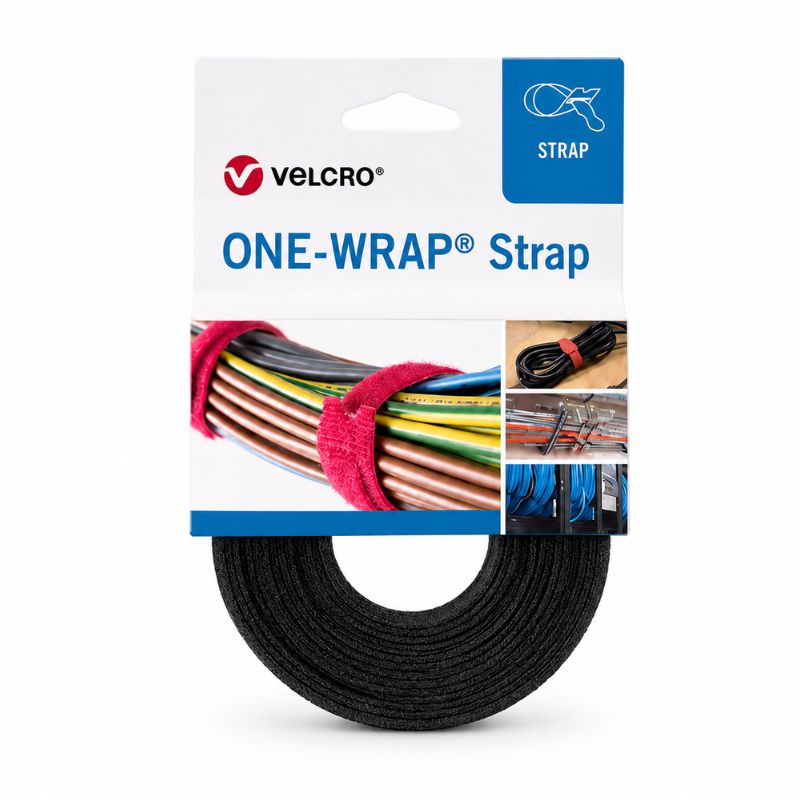
Velcro cable ties provide a reusable and adjustable way to secure cables while keeping them easy to access. Unlike traditional plastic cable ties, they can be opened and reused whenever changes are needed. This helps improve organisation, protects cables from over-compression, and makes maintenance significantly faster.


Want to find out more?
Are your cables constantly becoming tangled, difficult to identify, or time-consuming to maintain? This is a common challenge across industrial facilities, data centres, offices, and telecommunications installations. Poor cable management not only creates an untidy appearance but can also make troubleshooting more difficult and increase the risk of accidental cable damage. One of the most effective solutions is the use of Velcro cable ties.
Velcro cable ties use a hook-and-loop fastening system that securely bundles cables while allowing easy adjustment. Unlike traditional nylon cable ties, they can be opened and reused multiple times. This makes them particularly valuable in installations that regularly evolve or require ongoing maintenance.
The importance of cable management is often underestimated. Poorly organised cables can restrict airflow around equipment, increase strain on connectors, and make fault-finding more time consuming. In environments such as server rooms and control panels, organised cables can significantly reduce maintenance time and improve accessibility.
One major advantage of Velcro cable ties is cable protection. Standard plastic ties can be overtightened, creating unnecessary pressure on network, data, and communication cables. Excessive compression may affect performance and contribute to premature wear. Velcro ties apply gentler holding force, helping preserve the cable’s structure while still providing secure retention.
For best results, begin by grouping cables according to function. Keep power cables separate from data and communication cables wherever practical. Next, avoid creating oversized bundles. Several smaller bundles are often easier to trace, maintain, and modify.
Labelling should also form part of any cable management strategy. Combining cable labels with Velcro ties helps technicians identify cable routes quickly and reduces the risk of errors during maintenance.
A practical example can be seen in network infrastructure projects. When additional connections need to be installed, engineers can simply open the existing tie, add cables, and reseal the bundle. There is no need to cut and replace fasteners, reducing both labour and waste.
When selecting Velcro cable ties, consider bundle size, installation environment, and future expansion requirements. Choosing the correct specification ensures effective cable retention while maintaining flexibility.
At Fairline, customers regularly seek advice on practical cable management solutions that improve reliability and simplify maintenance. Velcro cable ties consistently provide an effective balance between organisation, protection, and convenience.
The takeaway is simple. Good cable management improves safety, accessibility, and long-term system performance. Velcro cable ties offer a reusable, cost-effective solution that benefits both engineers and end users while supporting future maintenance requirements.