
Best KVM Switches for Control Rooms
Control rooms depend on instant access to critical systems.
Whether managing security operations, transport networks, utilities, broadcasting or industrial facilities, operators need fast and reliable access to multiple computers and information sources.
A professional KVM solution allows operators to manage multiple systems efficiently while improving workspace ergonomics, security and operational resilience.
In this guide, we’ll explain which KVM technologies are best suited to modern control room environments.
Quick Answer
Matrix KVM and IP KVM systems are generally the preferred choice for control rooms because they support multiple operators, multiple systems and remote access while maintaining high reliability.
Why Control Rooms Need KVM Technology

Control room environments often involve:
- Multiple computers
- Multiple displays
- Critical decision making
- Continuous operation
Without KVM technology, operators would require multiple keyboards, monitors and workstations.
KVM systems simplify operations by providing:
✓ Centralised control
✓ Improved ergonomics
✓ Faster decision making
✓ Reduced hardware requirements
✓ Better operational efficiency
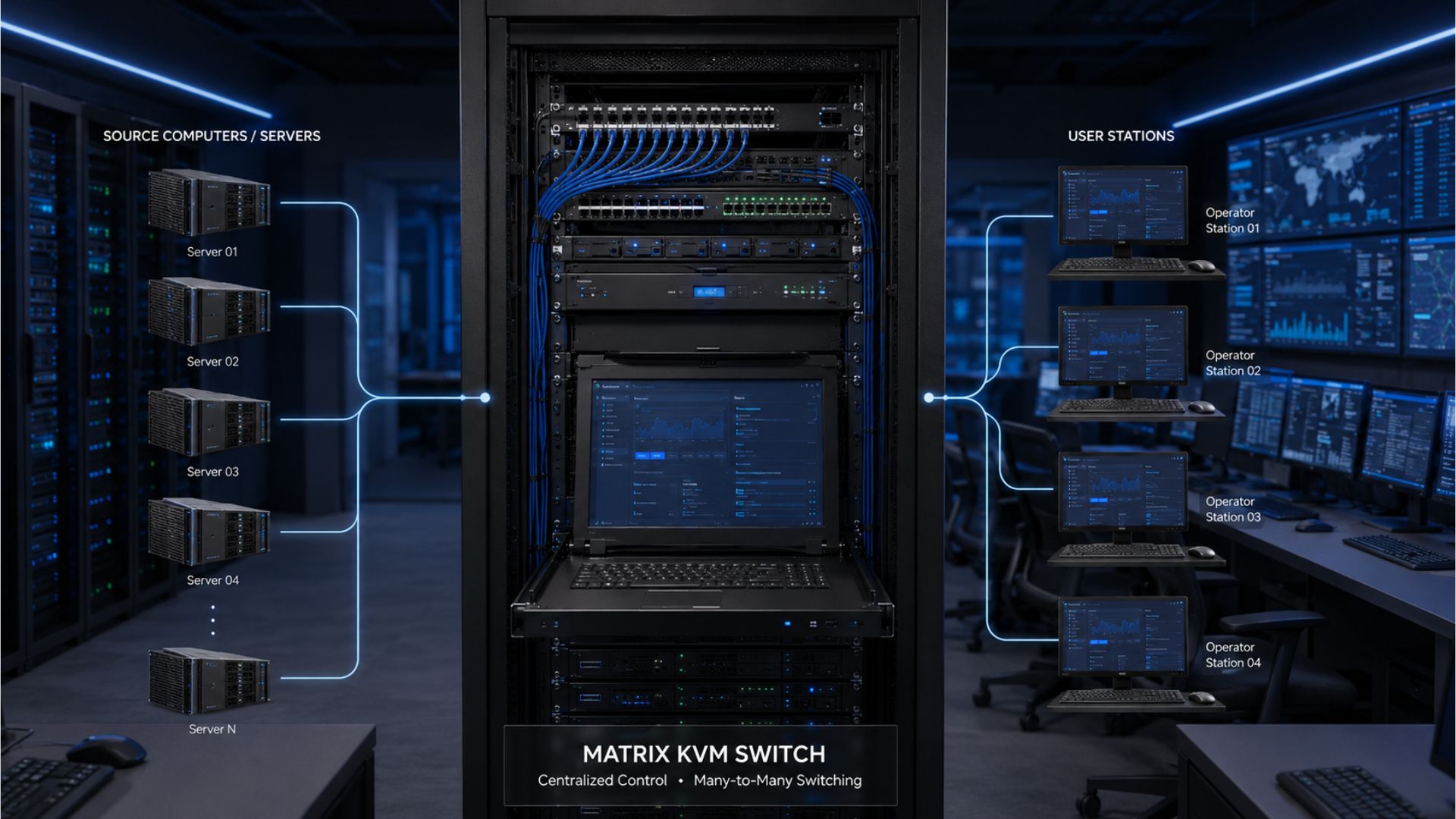
Matrix KVM Systems
Matrix KVM systems allow multiple users to access multiple computers dynamically.
This flexibility makes them the preferred solution for many professional control rooms.
Benefits include:
- User-to-system switching
- Flexible workstation layouts
- Centralised management
- Scalability
Best For
- Security control rooms
- Emergency response centres
- Broadcast operations
IP KVM Systems
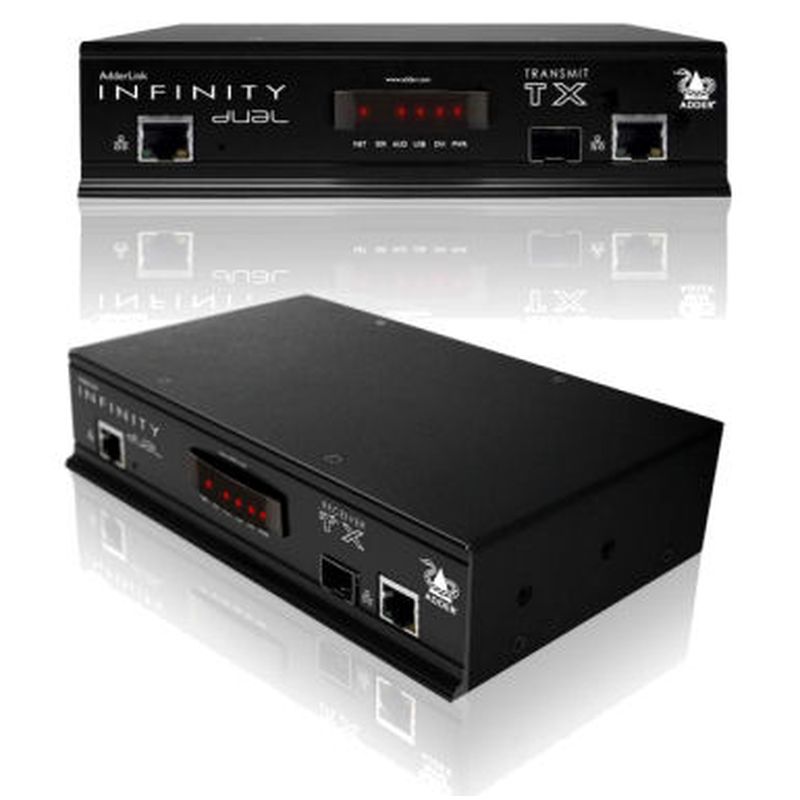
IP KVM systems allow computers to be managed across a network.
This provides:
- Remote access
- Disaster recovery capabilities
- Off-site support
- Flexible deployment
IP KVM solutions have become increasingly important as organisations adopt hybrid operations and remote management strategies.
Best For
- Utilities
- Transport operations
- Multi-site organisations

Multi-User KVM Solutions
Multi-user KVM systems allow several operators to access and interact with multiple systems simultaneously.
Benefits include:
- Shared resources
- Improved collaboration
- Reduced infrastructure costs
These solutions are commonly deployed within larger control room environments.
Comparison Table
| Solution | Best For | Scalability | Remote Access |
|---|---|---|---|
| Desktop KVM | Small teams | Low | No |
| Matrix KVM | Control rooms | Excellent | Optional |
| IP KVM | Remote management | Excellent | Yes |
| Multi-user KVM | Large operations | Excellent | Yes |
What Should You Look for in a Control Room KVM?
Reliability
Control rooms often operate 24/7. Reliability is critical.
Scalability
Systems should support future expansion.
Resolution Support
Modern control rooms increasingly require 4K support.
Security
Access control and user permissions are essential.
Redundancy
Mission-critical environments should consider failover capabilities.
Recommended Control Room KVM Brands

Adder Technology
Ideal for:
– Mission critical environments
– Control room deployments
– High-end matrix KVM systems

ATEN UK
Ideal for:
– Enterprise environments
– Flexible deployments
– Remote access solutions
Which KVM Solution Does Fairline Recommend?
Small Control Room Setups
ATEN KVM
Medium Control Room
ATEN Matrix KVM
Enterprise Operations Centre
Adder Matrix KVM
Multi-Site Operations
IP KVM Solutions
Frequently Asked Questions
What is the best KVM switch for control rooms?
Matrix KVM systems are typically the preferred solution due to their flexibility and scalability.
What is matrix KVM?
Matrix KVM allows multiple users to access multiple systems dynamically.
What is IP KVM?
IP KVM enables remote access to systems over a network.
When should I choose Adder or ATEN?
Both are excellent solutions. Adder is often favoured for mission-critical environments, while ATEN offers flexible solutions across a wider range of applications.

Fairline has supplied networking infrastructure products to UK businesses & installers for over 40 years.